Google is slowing piecing together a strategy for China to ensure that it doesn’t miss out on the growth of technology in the world’s largest country. It’s been months in the making through a series of gradual plays, but further evidence of those plans comes today via a product launch.
Files Go — a file manager for Android devices released last year — has made its way to China today. Not a huge launch, for sure, but the mechanisms behind it provide insight into how Google may be thinking about the country, where it has been absent since 2010 after redirecting its Chinese search service to Hong Kong in the face of government pressure.
For Files Go, Google is taking a partner-led approach to distribution because the Google Play Store does not operate in China. The company is working with Tencent, Huawei, Xiaomi and Baidu, each of which will stock the app in their independent app stores, which are among the country’s most prominent third-party stores.
Let that sink in a little: the creator of Android is using third-party Android app stores to distribute one of its products.
On the outside that’s quite the scenario, but in China it makes perfect sense.
There’s been regular media speculation in recent about Google’s desire to return to China which, during its absence, has become the largest single market for smartphone users, and the country with the most app downloads and highest app revenue per year. Mostly the rumors have centered around audacious strategies such as the return of the Google Play Store or the restoration of Google’s Chinese search business, both of which would mean complying with demands from the Chinese government.
Then there’s the politics. The U.S. and China are currently in an ongoing trade standoff that has spilled into tech, impacting deals, while Chinese premier Xi Jinping has taken a protectionist approach to promoting local business and industries, in particular AI. XI’s more controversial policies, including the banning of VPNs, have put heat on Apple, which stands accused of colluding with authorities and preventing free speech in China.
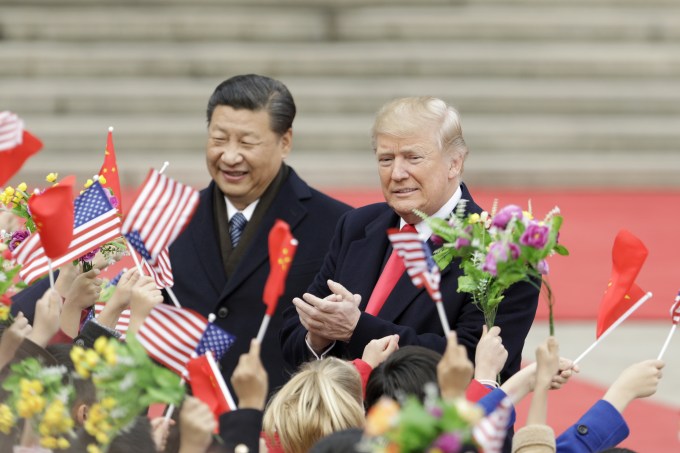
Political tension between the U.S. and China is affecting tech companies. [Photographer: Qilai Shen/Bloomberg via Getty Images]
It’s hardly surprising, then, that it hasn’t made big moves… yet at least.
Instead, it appears that the company is exploring more nimble approaches. There have been opportunistic product launches using established platforms, and generally Google seems intent at building relationships and growing a local presence that allows its global business to tap into the talent and technology that China offers.
Files Go is the latest example, but already we’ve seen Google relaunch its Translate app in 2017 and more recently it brought its ARCore technology for augmented and virtual reality to China using partners, which include Xiaomi and Huawei.

Bouquets of flowers lie on the Google logo outside the company’s China head office in Beijing on March 23, 2010 after the US web giant said it would no longer filter results and was redirecting mainland Chinese users to an uncensored site in Hong Kong — effectively closing down the mainland site. Google’s decision to effectively shut down its Chinese-language search engine is likely to stunt the development of the Internet in China and isolate local web users, analysts say. (Photo credit: xin/AFP/Getty Images)
Beyond products, Google is cultivating relationships, too.
It inked a wide-ranging patent deal with Tencent, China’s $500 billion tech giant which operates WeChat and more, and has made strategic investments to back AI startup XtalPi (alongside Tencent), live-streaming platform Chushou, and AI and hardware company Mobvoi. There have been events, too, including AlphaGo’s three-game battle with Chinese grandmaster Ke Jie in Wuzhen, developer events in China and the forthcoming first Google Asia Demo Day, which takes places in Shanghai in September.
In addition to making friends in the right places, Google is also increasing its own presence on Chinese soil. The company opened an AI lab in Beijing to help access China-based talent, while it also unveiled a more modest presence in Shenzhen, China’s hardware capital, where it has a serviced office for staff. That hardware move ties into Google’s acquisition of a chunk of HTC’s smartphone division for $1.1 billion.
The strategy is no doubt in its early days, so now is a good time to keep a keen eye on Google’s moves in this part of the world.


from TechCrunch https://tcrn.ch/2H5IAvy
Comments
Post a Comment